Website + Lead Capture

A website that turns visitors
into calls and bookings.

Every design choice we make has a reason behind it. Here's the research we lean on, and the process we follow before a single page gets built.

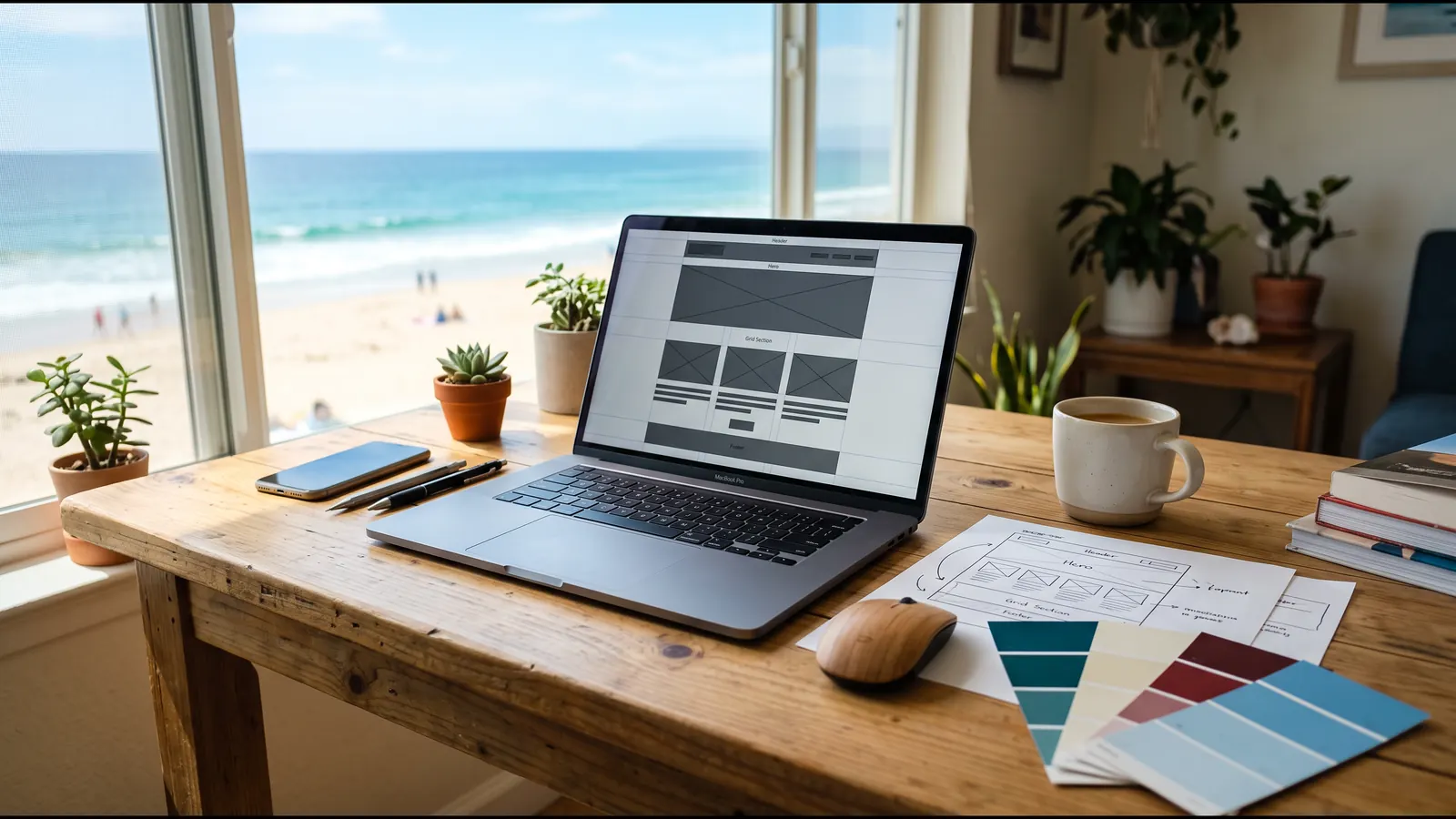
A designer's desk with a website wireframe on a laptop, paper layout sketches and color swatches

Website design at Full Plate means a fast, mobile-first site built around how people actually read, decide and trust, with every call and form landing somewhere you'll see it. We're based in Kill Devil Hills on the Outer Banks and build sites for businesses across North Carolina and Virginia.

You have a website nobody looks at

It took forever to build. It looks fine on your laptop. But it's slow on a phone, the contact form goes to an inbox nobody checks, and you have no idea whether it brings in a single customer. Your website should be your hardest-working employee, not a business card nobody reads.

Why we show our research, not a portfolio

Every business owner pictures a different website, and that's how it should be. Your site should look like you. So instead of showing off sites we built for other people, we'd rather show you how we think. These are the ideas behind every site we build.

Behind the scenes

The psychology behind a site that works

Every claim here links to its source. If we can't back it up, we don't build on it.

You get about a blink to make a first impression

Researchers led by Gitte Lindgaard at Carleton University found people judge a web page's visual appeal in as little as 50 milliseconds, faster than they can read a word. The top of your homepage has to look clean and trustworthy right away.

Source: Lindgaard et al., Behaviour & Information Technology, 2006

Looks build trust

In a Stanford study of more than 2,600 people judging websites, nearly half (46.1%) based their sense of a site's credibility partly on its overall visual design. A dated or messy site quietly tells people your business might be dated or messy too.

Source: Stanford Web Credibility Project, 2002

People scan, they don't read

Eye-tracking research shows people often scan pages in an F-shaped pattern: across the top, then down the left side. So we put the important things first, write headings that actually say something, and break text into short chunks.

Source: Nielsen Norman Group

Speed is part of the design

Google found that 53% of mobile visits are abandoned when a page takes longer than three seconds to load. We compress images, keep the code lean and test on real phones.

Source: Think with Google, 2017

Fewer choices, faster decisions

Hick's law says the more options people face, the longer they take to decide. So every page we build points to one clear next step, like calling, booking or getting a quote, instead of ten competing buttons.

Source: Hick and Hyman, 1952, via Laws of UX

Color matters, but not the way the internet says

You'll read that blue means trust and red means urgency. The research is far less settled than that. A 2015 review by psychologist Andrew Elliot called color psychology a young field whose effects depend heavily on context. What holds up: strong contrast so text is easy to read, consistent colors so people recognize you, and colors that fit what you do.

Sources: Elliot, Frontiers in Psychology, 2015 and W3C contrast guidelines (at least 4.5 to 1 for regular text)

Our process

Our research, before we design a thing

  1. Learn your customers

    Who they are, what they need to find in the first few seconds, and the questions they ask you most.

  2. Study your search data

    What people type into Google to find businesses like yours, and what they ask AI tools.

  3. Look at your competitors

    What they do well, where they fall short, and how you'll stand apart.

  4. Plan the path

    Wireframes first: what goes where on each page, and the one action every page leads to.

  5. Design, build, test

    Your brand on top of that plan, then tested on real phones before launch.

Want us to look at your current site? Book a free Kitchen Check

What's included

What we build

Fast and mobile-first

Designed for the phone first, because that's where most of your visitors are.

Clear ways to reach you

Call, text or book from every page, with one obvious next step.

Every lead captured

Every form and call lands in one place, connected to your follow-up system.

Built for Google and AI search

Clean structure, local details and structured data that search engines can read. More on our lead generation page.

Easy to update

Change your hours, photos and specials yourself, or let us handle it.

Online stores

Shopify builds for businesses that sell products, made to check out easily on a phone.

You own it

Your domain, your site, your content. We set everything up in your name. If we ever part ways, it all goes with you.

What affects the cost

We don't publish prices, because every business starts in a different place. We meet you where you are and build from there. These are the things that shape the investment:

  • How many pages you need
  • Whether you sell products online
  • How much writing and photography we handle
  • Connections to tools like booking, scheduling or your customer database
  • Whether we handle hosting and updates after launch

The Friday scoreboard

Every Friday you get a one-page report showing what came in and where it came from. Readable in two minutes, so you always know what you're paying for.

Frequently asked questions

How much does a website cost?

It depends on how many pages you need, whether you sell online, and how much writing and photography we handle. We don't publish prices because every business starts in a different spot. In a free Kitchen Check we learn what you need and give you clear options.

How long does it take to build a website?

Most small business sites take three to six weeks from kickoff to launch. Online stores and larger sites take longer. The biggest factor is usually how quickly we get content and feedback, so we keep the process simple on your end.

Can I update my website myself?

Yes. We show you how to make everyday changes like hours, photos and specials. If you would rather not touch it, we can handle updates for you.

Do I own my website?

Yes. The domain, the content and the site are yours. We set things up in your name, and if we ever part ways, everything goes with you.

Will my new website show up on Google?

We build every site so search engines can read it: fast pages, clear headings, local details, structured data and a sitemap. Ranking also depends on your Google profile, your reviews and your competition, which is what our lead generation work covers.

Do you use templates?

We use proven building blocks so your site is fast and reliable, but the design and the words are made for your business. Your site should look like you, not like the agency that built it.

Who handles hosting, security and updates?

We can. We set up reliable hosting, keep the site secure and up to date, and fix anything that breaks. If you already have hosting you like, we can work with that instead.

Why don't you show a big portfolio?

Because your website shouldn't look like someone else's. We would rather show you our thinking: the research and process behind every decision. This website is one example of our work, and we are happy to walk you through it during your Kitchen Check.

Can you build an online store?

Yes. We build Shopify stores for businesses that sell products, set up so customers can browse and check out easily on a phone.
Got questions about your website? Let's talk.

No pitch and no obligation. If you just want a sounding board for your business, we're happy to be that. Honestly, these are some of our favorite conversations.

Book a free Kitchen Check

Or call us at (252) 256-7046.